The most powerful load optimization engine on the market, calibrated on thousands of real loads. Get space-efficient, axle-legal load plans for any truck or container in our 3D software. Or skip the screen: just tell Loadgent, our AI agent, what you need in a chat, and you, your team or your customers get the same optimized load, sent to your ERP.
Higher load-space utilization means fewer trucks per order, less freight and less CO₂ per shipment.
Paste or import the cargo list, get a 3D load plan and a step-by-step load sheet your dock crew can follow.
Weight limits, axle loads, stacking strength, fragile items and loading sequence. Not theoretical packing.
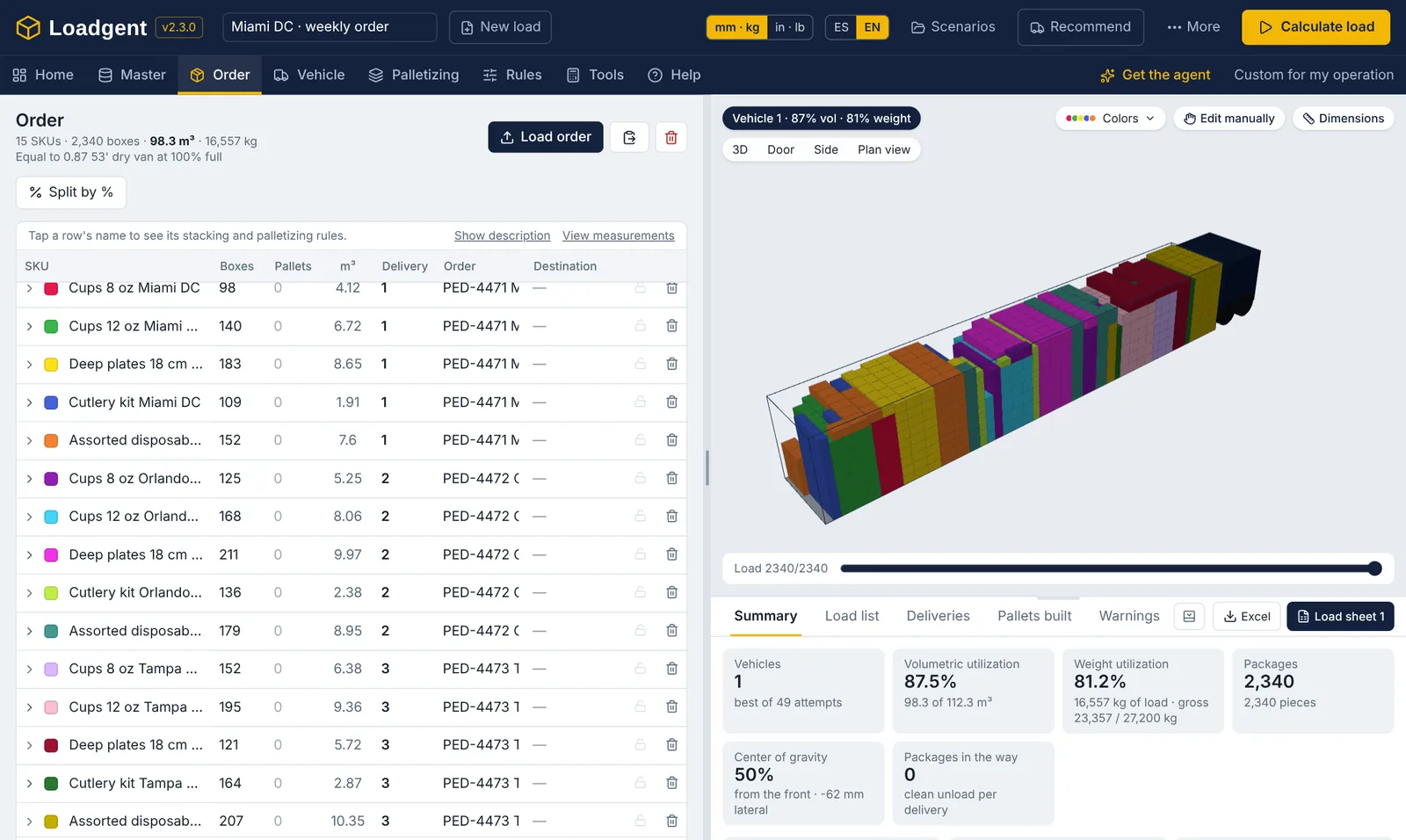
Import your cargo list from Excel, pick the truck or container and get an operator-ready load plan in 3D: filling rate, axle loads, the load sheet for your dock and every unplaced item listed. No agent needed, no call needed.
14 days free, no card. Then from $79 a month plus tax for your planning team. Plans below.
Two separate decisions. The engine is what your team uses every day. The agent is what your customers use instead of calling you. Every plan starts with 14 days free — no card, no contract, cancel any month. Already convinced? Buy now and pay securely by card.
Add them to any plan, drop them any month.
Not sure which plan fits? Book a 20-minute call and we'll size it with one of your real orders. One price for the company, however many people open it. The agent is priced on the orders it actually completes, so it costs what it earns.
Every load planner draws a tight 3D plan. Ours adds mathematical models of what really happens on the dock: cases that give under weight, gaps between mixed SKUs, loaders who only turn what they can. Calibrated on thousands of real loads, so the plan is the load your crew can actually build.
Bags give under the weight above them, the bottom one most. Rigid cases don't. Palletized freight doesn't.
Cases load upright like a real wall. They turn only where it gains space: the sidewall, the ceiling, the last void.
Different case sizes never lock perfectly. The engine reserves the space you really lose, so it never over-promises.
When space is left, it suggests exactly which cases to add, or what to cut to save a trailer.
Light freight cubes out, heavy freight weighs out. Loadgent fills to whichever comes first.
The customer orders in their own words — no tool to learn, no template to fill. The agent keeps the truck full, suggests what to add or take out, and once they confirm, the order lands in your ERP, goes to the dock and gets delivered. WhatsApp is where we start, because it's where orders already arrive.
Today a full truck takes rounds of emails between the customer, sales and logistics. With Loadgent the customer gets the answer while they order.
A tile plant, a beverage distributor and a parts maker load nothing alike. So the software bends to you, not the other way around — your shapes, your rules, your fleet, your freight rates, even the way your dock sequences a truck.
Twenty minutes with the people who built the engine. We'll tell you straight whether your case is worth customizing.
Loadgent sits between the channels your customers use and the systems you already run. Nothing is retyped.
Plan a loadSend an order, get the plan, the truck and the load sheet.Recommend a truckThe cheapest vehicle that fits, with your rates.Fill the orderHow many more cases fit before it cubes or weighs out.Item masterCase sizes, weights and stacking rules kept in sync.WebhooksYour system hears the moment a plan or an order is ready.Planners, operations and warehouse leads who put real orders into Loadgent and told us what came out.
"I've tried other programs and none was as optimal or as realistic. The constraints you can apply and the processing speed are incredible."
"My customer builds his own container with the agent, sees the freight, and sends the order right there."
"I asked for customizations and they designed the whole process for me: order, planning, loading and delivery."
"The loader gets the diagram and that's it. Dead easy."
Translated from Spanish. Job titles are each person's own role; their employers are not Loadgent customers.
It plans the load your crew can actually build: compression, voids between mixed cases, where loaders rotate and where they don't. And anyone can ask it in plain words through the AI agent — your customers included.
Customers adjust quantities with the agent until the truck is full, so sales no longer relays questions to logistics and back. The confirmed order arrives with its load sheet.
No. It runs in the browser. Your customers use WhatsApp or web chat.
Upload your products and trucks from Excel and plan the same day. Enterprise setups with your own rules and integrations take a few weeks.
Yes. It models non-box shapes, nesting pieces and products that compress, and keeps pallets and loose cases in the same load.
Yes. It stops when you weigh out, shows the center of gravity and warns when an axle goes over its limit.
No. Customers only pick products and quantities. Your rules stay in your catalog.
English and Spanish. Metric or imperial, switch any time.
Because they are two different things. The engine is a tool your team opens: one price for the company, however many people use it. The agent is a conversation with your customer that costs money every time it runs — the messages and the model behind it. Charging it per completed order keeps the base price honest and lets you add or drop it any month.
A conversation that ends with a confirmed, cubed order sent to your systems. Questions that go nowhere, abandoned carts and your own team's tests don't count.
Yes. Monthly plans, no contract.
We run it on your products and your trucks, and show you how full your trailers could leave. Twenty minutes, no slides. Bring an Excel, a PDF, or a photo of the order.